Introduction
Choosing the right MDF thickness for a shelf is one of the most common — and most underestimated — decisions in woodworking. Too thin, and the shelf sags under load. Too thick, and you waste money and add unnecessary weight to your furniture.
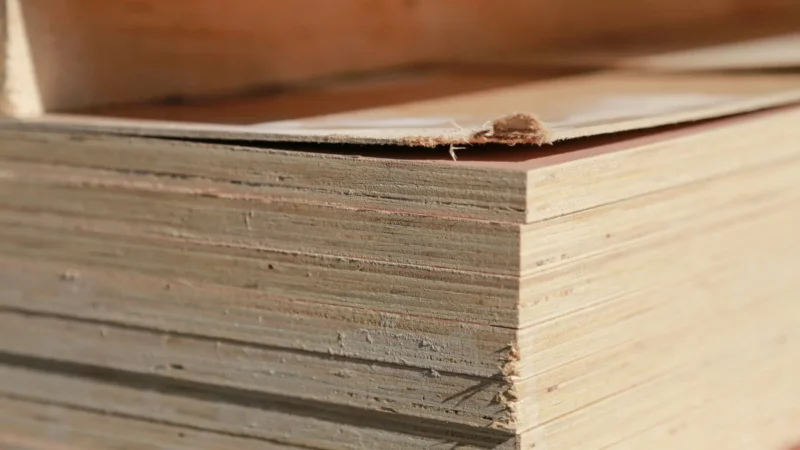
MDF (Medium Density Fibreboard) is a composite panel made from compressed wood fibres and resin. Its density ranges from 700 to 800 kg/m³, making it heavier and more uniform than plywood — but also more sensitive to bending over long spans.
This guide covers the four most common MDF thicknesses (12mm, 16mm, 18mm, 22mm), explains how shelf deflection works, and gives you a clear chart to match thickness to span and load. Whether you’re building a bookcase, a wardrobe shelf, or workshop storage, you’ll find a concrete recommendation here.
Why MDF Deflects — and What That Means in Practice
Deflection is the amount a shelf bends downward under load. It’s measured in millimetres at the centre of the span. Structural engineers typically consider L/300 as the maximum acceptable deflection — where L is the span in millimetres.
For a shelf with an 80 cm (800 mm) span, that means a maximum acceptable sag of 800 ÷ 300 = 2.7 mm. Beyond that, the shelf looks visually wrong, and the long-term integrity of the panel is at risk.
MDF has a modulus of elasticity (E) of approximately 3,500 MPa. This is lower than plywood (around 8,000–10,000 MPa) and much lower than solid wood like oak (around 12,000 MPa). That lower stiffness means MDF is more prone to deflection under identical conditions.
The deflection formula for a uniformly distributed load is:
δ = (5 × w × L⁴) / (384 × E × I)
Where:
You don’t need to run this manually. The shelf deflection calculator on Offcut handles all inputs and gives you an instant result.
MDF Thickness Chart by Span and Load
The table below gives practical guidance for standard shelf configurations. Load values are expressed as total distributed load across the full span (not point loads at the centre).
- 18mm MDF over an 80 cm span supports approximately 20 kg before reaching the L/300 deflection threshold.
- 16mm MDF over the same span begins to sag visibly above 12–14 kg.
- Each additional millimetre of thickness increases stiffness disproportionately — because the second moment of area (I) grows with the cube of thickness.
| MDF Thickness | Max Recommended Span | Light Load (< 10 kg) | Medium Load (10–20 kg) | Heavy Load (> 20 kg) |
|---|---|---|---|---|
| 12 mm | 50 cm | ✅ Acceptable | ⚠️ Borderline | ❌ Not suitable |
| 16 mm | 70 cm | ✅ Good | ✅ Acceptable | ⚠️ Borderline |
| 18 mm | 80–90 cm | ✅ Good | ✅ Good | ⚠️ Borderline |
| 22 mm | 100 cm | ✅ Good | ✅ Good | ✅ Acceptable |
| 25 mm | 120 cm | ✅ Good | ✅ Good | ✅ Good |
Key figures to remember:
> Key takeaway: Going from 16mm to 18mm doesn’t just add 2mm — it increases bending stiffness by roughly 42%. Going from 18mm to 22mm adds another 63% of stiffness. Thickness matters far more than most people expect.
16mm vs 18mm MDF for Shelving: When Does It Actually Matter?
This is the most common question among DIY woodworkers and furniture makers. The short answer: it depends on your span, not your load alone.
For a wardrobe shelf of 50–60 cm carrying folded clothes, 16mm is entirely adequate. The load is moderate, the span is short, and deflection remains within safe limits.
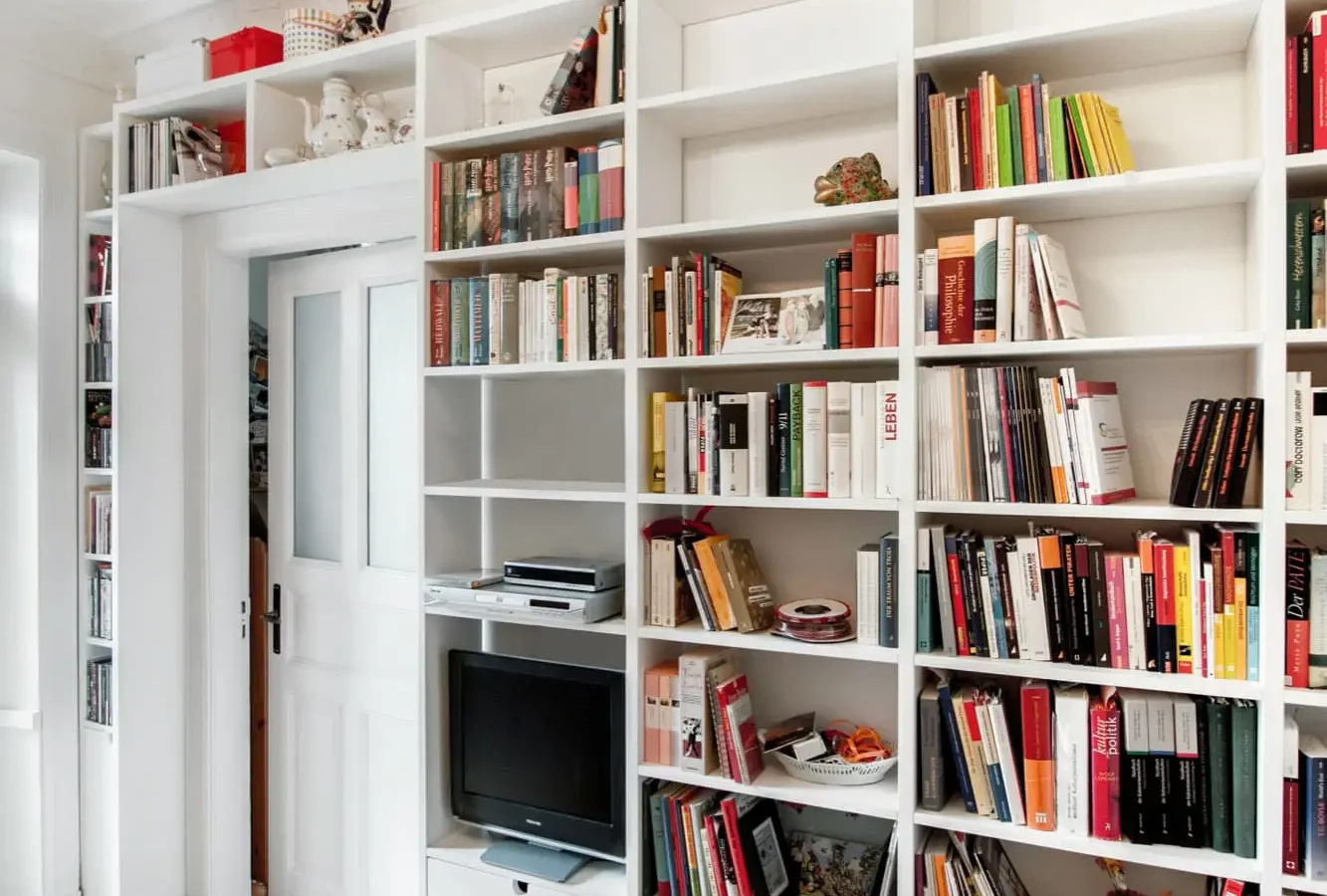
For a bookcase shelf spanning 80 cm holding hardback books — which easily reach 20–25 kg per shelf — 16mm will visibly sag within months. The L/300 threshold is exceeded, the shelf looks unprofessional, and the MDF may develop a permanent set.
Use 16mm MDF when:
Use 18mm MDF when:
Use 22mm or above when:
For borderline cases — spans near 80–90 cm with medium loads — adding a 40mm front lipping (a strip of MDF or solid wood glued to the front edge) dramatically increases stiffness without adding significant cost. This is a common technique used in kitchen cabinet construction.
To run your exact configuration, use the shelf load calculator which accepts your span, thickness, width, and load — and tells you whether your setup stays within acceptable deflection limits.
Practical Examples: Choosing Thickness for Real Projects
Example 1 — Living room bookcase, 80 cm wide shelves
Books weigh roughly 20–25 kg per running metre. An 80 cm shelf fully loaded = 16–20 kg. At this span, 18mm MDF deflects approximately 2.5 mm — just within the L/300 limit. Recommended: 18mm with front lipping, or 22mm without.
Example 2 — Wardrobe shelf, 100 cm wide
Folded clothing is lighter — typically 5–8 kg per shelf. But 100 cm is a long span for MDF. Even with a low load, 16mm will sag noticeably. Recommended: 18mm minimum, ideally supported at mid-span by a central divider.
Example 3 — Workshop storage, heavy tools
Power tools can reach 15–30 kg on a single shelf. Any span over 60 cm with this load exceeds 18mm MDF capacity. Recommended: 22mm or 25mm MDF, or switch to birch plywood for better stiffness-to-weight ratio.
Once you’ve determined your panel thickness, optimising how you cut your sheet minimises waste. The panel cut optimiser lets you input your shelf dimensions and automatically arranges cuts to reduce offcuts — useful when ordering standard 244 × 122 cm sheets.
Conclusion
MDF is a reliable, cost-effective material for shelving — as long as you match thickness to span and load. The rule is simple: never underestimate deflection. A shelf that looks fine on day one may sag permanently within a year under consistent load.
The practical default for most home furniture is 18mm MDF up to 80–90 cm spans. Beyond that, step up to 22mm or reinforce with front lipping and a back panel. For heavy workshop storage over long spans, consider plywood instead.
Use the shelf deflection calculator to verify your specific configuration before cutting. It takes 30 seconds and can save you from a costly mistake. Once your thickness is confirmed, plan your panel cuts efficiently with the Offcut optimiser to minimise waste.