Introduction
Choosing between MDF and plywood for shelves is one of the most common decisions woodworkers and DIYers face. Both materials are widely available, relatively affordable, and easy to cut — but they behave very differently under load.
An 18mm MDF shelf spanning 90 cm will visibly sag over time under moderate weight. The same shelf in 18mm birch plywood will hold significantly more without deflecting. This single difference changes everything when designing shelving units, bookcases, or kitchen cabinets.
This article breaks down the key criteria — weight, strength, moisture resistance, price, and workability — so you can make the right choice for your specific project.
Head-to-Head Comparison: MDF vs Plywood for Shelves
Before diving into each criterion, here is a direct comparison of the two materials on the factors that matter most for shelving applications.
| Criterion | 18mm MDF | 18mm Birch Plywood |
|---|---|---|
| Density | 700–800 kg/m³ | 500–700 kg/m³ |
| Weight (per m²) | ~13.5 kg | ~9–10 kg |
| Max recommended span (unsupported) | 60–70 cm | 80–100 cm |
| Approx. load capacity (10 cm wide shelf) | ~10–15 kg/linear m | ~20–30 kg/linear m |
| Moisture resistance | Poor (swells) | Moderate to good (BB/WBP grade) |
| Surface finish | Smooth, paint-ready | Requires sanding/filling |
| Edge finish | Needs banding or filler | Clean, sandable |
| Relative price (per 244×122 cm sheet) | Lower (~£20–35) | Higher (~£35–70) |
| Screw holding (face) | Good | Good |
| Screw holding (edge) | Poor | Better |
MDF is approximately 30–35% heavier than equivalent plywood. For a full-height bookcase, that weight difference matters both during assembly and for wall fixings. Use the wood panel weight calculator to get exact figures for your sheet dimensions and thickness.
Strength and Deflection: The Key Factor for Shelves
Strength is where MDF and plywood diverge most sharply — and it’s the single most important criterion for shelving.
Why MDF sags
MDF is made from wood fibres compressed with resin under heat and pressure. The result is a uniform, dense panel — but one that lacks the cross-grain structure of plywood. Under sustained load, MDF creeps: it deforms gradually over months, even if the initial weight seems manageable.
The critical span for MDF is approximately 60–70 cm. Beyond that, even 18mm MDF will noticeably deflect under a load of books or ceramics. If you need longer unsupported spans, you must either increase thickness to 22–25mm, add a front rail, or switch to plywood.
Why plywood holds better
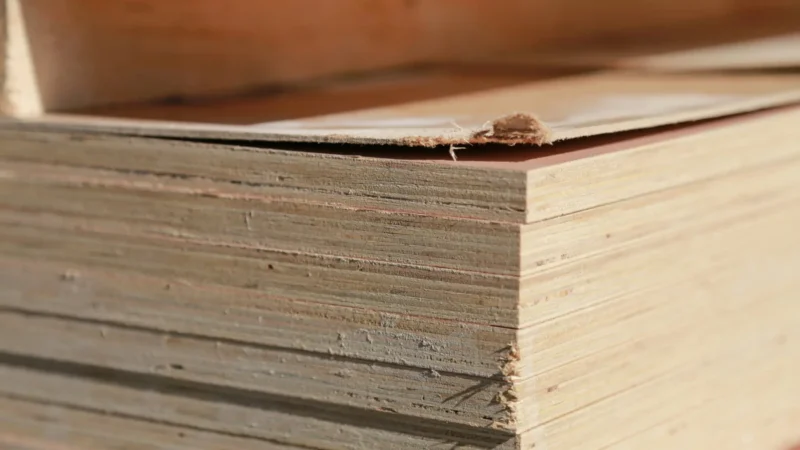
Plywood is built from alternating layers of veneer glued at 90° to each other. This cross-laminated structure distributes stress across the grain direction, giving plywood a much higher modulus of rupture than MDF. A 15mm birch plywood shelf can often outperform an 18mm MDF shelf over the same span.
For spans of 80–100 cm carrying significant loads, 18mm birch or poplar plywood is the standard recommendation among professional cabinetmakers. For spans beyond 100 cm, consider 22mm plywood or add an intermediate support.
Want to calculate exactly how much deflection to expect? The shelf deflection calculator gives you precise results based on your panel thickness, span, and expected load — for both MDF and plywood.
Weight, Moisture, and Workability
Weight
MDF is heavier. A standard 244×122 cm sheet of 18mm MDF weighs approximately 32–35 kg. The equivalent birch plywood sheet weighs around 22–26 kg. This 30% weight difference has practical consequences:
If you’re building a large shelving unit with multiple panels, the cumulative weight difference is significant. You can verify your exact panel weights using the wood panel weight calculator before ordering materials.
Moisture resistance
MDF absorbs moisture readily and swells — particularly at the edges. In kitchens, bathrooms, or any humid environment, standard MDF is a poor choice without a complete sealing system (all faces and edges). Moisture-resistant MDF (MR MDF, often green in colour) offers some improvement but is not waterproof.
Plywood performs significantly better in humid conditions, especially exterior-grade or WBP (Weather and Boil Proof) plywood. For kitchen shelves or utility rooms, plywood is the safer long-term choice.
Workability and finishing
MDF has real advantages here. It machines cleanly, routes beautifully, and accepts paint evenly with minimal preparation. Edges are smooth and consistent — ideal for painted cabinetry or decorative shelving where appearance matters.
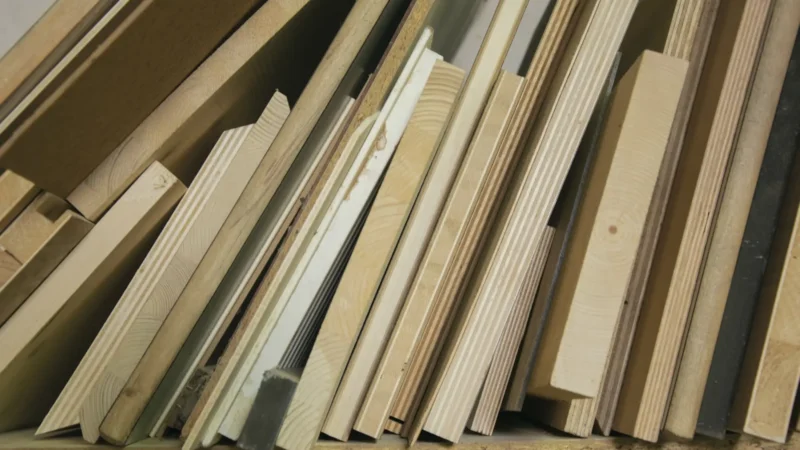
Plywood requires more surface preparation for a painted finish: sanding, grain filling, and sometimes a skim coat of filler. Edges are visibly layered (which some designers leave exposed intentionally). However, plywood holds screws far better at the edges — a critical advantage when assembling carcasses or fixing shelf pins.
When to Choose MDF, When to Choose Plywood
The decision is not always obvious. Here is a practical guide based on common shelving scenarios.
Choose MDF when:
Choose plywood when:
For bookcases and workshop shelving, professional woodworkers almost universally prefer plywood. For built-in bedroom storage with short spans and a paint finish, MDF remains a perfectly valid and cost-effective choice.
Once you’ve decided on your material, the next step is minimising waste when cutting your sheets. An online cut optimisation tool helps you plan your cuts across full panels, reducing off-cuts and saving money on materials.
Conclusion
MDF and plywood are both useful materials — but they are not interchangeable for shelving. The choice comes down to three questions: How long is your span? How heavy is the load? What environment will the shelves live in?
For spans under 70 cm, light loads, and a painted finish, MDF is practical and affordable. For anything longer, heavier, or more exposed to moisture, plywood is the correct structural choice — and the one that will perform without sagging or swelling over time.
Take the guesswork out of your material calculations. Use the shelf deflection calculator to verify your panel thickness for your exact span and load, and the wood panel weight calculator to plan your fixings and transport. When you’re ready to cut, plan your cuts with Offcut to minimise waste and get the most out of every sheet.