At the panel section of your timber merchant, there’s no shortage of choice: MDF, OSB, plywood, chipboard… Each family has its advantages, its limits, and its preferred uses. This comparative guide helps you choose the right panel for your project — without picking the wrong material.
Why panel choice matters
The wrong panel choice can ruin an entire project. MDF in a bathroom? It’ll swell and fall apart. OSB for kitchen cabinet carcasses? The rough surface and uneven edges will make finishing a nightmare. Conversely, choosing marine plywood for a simple office shelf is paying far more than needed.
The right panel depends on three variables: the final use (furniture, flooring, walls…), the environment (dry, damp, outdoor) and the budget. Let’s go through each in detail.
Chipboard (particle board)
What it is
Chipboard is made from wood chips and sawdust compressed under pressure with resin. It’s the base material of the flat-pack furniture industry — Ikea relies on it heavily.
Strengths
- Price: the cheapest panel on the market, raw or melamine-faced
- Smooth surface: melamine-faced chipboard (chipboard covered with a decorative film) delivers a clean finish without sanding or painting
- Flatness: very dimensionally stable in dry conditions
- Wide decor range: hundreds of colours and textures available
Weaknesses
- Moisture-sensitive: chipboard swells and deteriorates on contact with water. Not suitable for damp rooms without serious protection
- Fragile edges: edges crumble if not covered (ABS edging, wood veneer)
- Less strong than plywood: flexes on long spans or under heavy loads
- Poor re-use: repeated screwing tears the material
Best for
Bedroom furniture, light shelving, standard kitchen carcasses, office furniture. Anywhere appearance matters and the environment is dry.
MDF (Medium Density Fiberboard)
What it is
MDF is made from very fine wood fibres, compressed and bonded with resin. Unlike chipboard (chips) or plywood (veneers), MDF is completely homogeneous — no grain, no knots, no figuring.
Strengths
- Perfect paint surface: the ultra-smooth texture takes paint better than any other panel
- Precise machining: routing, moulding, profiling — MDF handles everything without chipping
- Homogeneous throughout: edges work as well as faces
- Mid-range price: more than chipboard, less than plywood
Weaknesses
- Very moisture-sensitive: even more than chipboard, standard MDF swells quickly. Moisture-resistant MDF exists (green-tinted) but still needs protection
- Heavy: an 18 mm MDF panel weighs around 28 kg/m², versus 22 kg for the same-thickness plywood
- Toxic dust: sanding MDF generates fibres and resins. Always wear an FFP2 mask
- Tricky screwing: holds screws less well than chipboard or plywood, especially at edges
Best for
Painted furniture fronts, detailed interior decor, mouldings, cladding, high-end bespoke furniture in dry environments.
Plywood
What it is
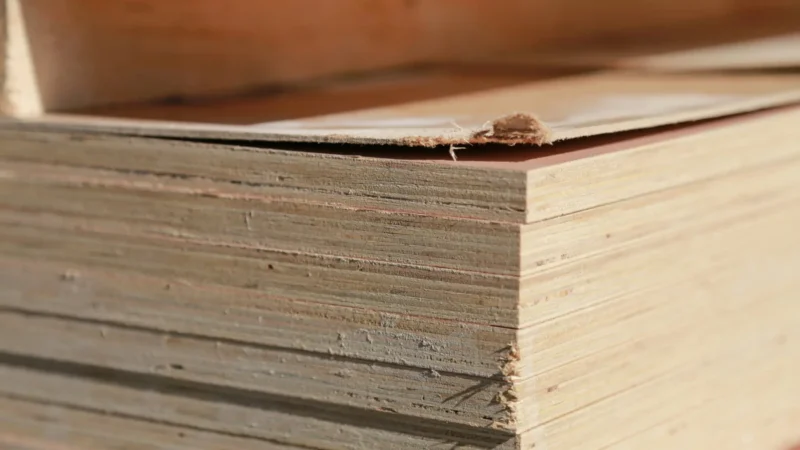
Plywood consists of wood veneers (plies) glued with fibres alternating at 90°. This cross-lamination gives it exceptional mechanical strength in all directions.
Strengths
- Strength: plywood carries heavy loads without flexing, even over long spans
- Moisture resistance: in exterior grade (WBP or marine bonding), it handles tough conditions well
- Relatively lightweight: stronger for its weight than MDF
- Holds fixings well: screws, dowels, bolts — it accepts everything
- Naturally attractive: certain plywoods (birch, okoume) have a pleasing decorative face without treatment
Weaknesses
- Price: the most expensive of the family, especially birch or marine grades
- Uneven surface: knots, grain variation on faces, especially in standard quality
- Visible edges: the stack of plies shows on the edge — can be decorative or need covering depending on use
Best for
Structural furniture, long-span shelving, exterior joinery, visible-quality cabinet backs, projects requiring strength and durability.
OSB (Oriented Strand Board)
What it is
OSB is made from large oriented wood strands, cross-layered and pressed. It’s recognisable by its rough, irregular look, with those long chips clearly visible.
Strengths
- Structural strength: excellent for racking resistance and timber frame construction
- Attractive price: cheaper than plywood for comparable structural performance
- Availability: stocked everywhere, including DIY superstores
Weaknesses
- Rough, uneven surface: very difficult to paint or finish cleanly
- Not for furniture: edges impossible to finish properly, unattractive appearance
- VOC emissions: resins used (formaldehyde-based) can off-gas volatile organic compounds, especially indoors
Best for
Flooring, walls and roofs in timber frame construction, concrete formwork. Not for furniture or visible finishes.
Comparison table
| Criterion | Chipboard | MDF | Plywood | OSB |
|---|---|---|---|---|
| Price (18 mm, €/m²) | 8–14 | 12–18 | 18–35 | 10–16 |
| Mechanical strength | Medium | Good | Very good | Very good |
| Moisture resistance | Low | Low (MR grade: medium) | Good (ext.) | Medium |
| Surface finish | Good (melamine) | Excellent | Variable | Poor |
| Machinability | Good | Excellent | Good | Poor |
| Weight (18 mm) | 26 kg/m² | 28 kg/m² | 22 kg/m² | 17 kg/m² |
| Indoor furniture use | ✓✓ | ✓✓ | ✓✓ | ✗ |
| Outdoor / damp use | ✗ | ✗ (MR: ±) | ✓ (ext.) | ± |
Which thickness to choose?
- 8–10 mm: cabinet backs, lightweight decorative panels
- 16 mm: short shelves (under 60 cm span), small cabinet carcasses
- 18 mm: standard for furniture (carcasses, bookcases, chests)
- 22 mm: long-span shelves (over 80 cm), worktops, desk tops
- 25–30 mm: kitchen worktops, solid tops
For more on choosing thickness, see our article Wood panel thickness: 16, 18 or 22 mm — how to choose?
How to optimise your purchase
Once you’ve chosen your panel, the challenge is buying the right quantity — not too much, not too little. That’s where a well-made cutting layout makes all the difference. By optimising piece placement across each panel, you reduce waste and avoid buying one panel too many.
Use app.offcut.tools to generate your cutting layout automatically. Enter your pieces and their material, and the tool tells you how many panels to buy and where to cut. Simple, fast, free.
For more on cutting layout optimisation, read our guide Panel cutting layout: a complete beginner’s guide.
Summary: how to choose
- Is the environment damp? If yes → exterior plywood or moisture-resistant MDF with protection. Standard chipboard and MDF should be avoided.
- Will the panel be visible? If yes and you’re painting → MDF. If you want natural wood → birch or okoume plywood.
- What’s your budget? Tight → melamine chipboard. Mid-range → MDF. Higher / quality required → plywood.
OSB doesn’t belong in any furniture project. Keep it for construction.
Offcut tools to go further
- 📊 Wood weight calculator — estimate the mass of your panels instantly, before assembly or transport.
- 📐 Shelf deflection calculator — check the strength and predicted sag of your shelves under load.
- 🪵 Offcut app — cutting plan — generate an optimised cutting plan in a few clicks.