Introduction
Drawer slides seem like a minor detail — until a drawer sticks, sags, or falls out entirely. Choosing the right slides affects how long your furniture lasts, how much weight it can carry, and how the end user actually feels about opening a drawer every day. Ball bearing slides, full extension slides, and push-open (tip-on) mechanisms each solve a different problem. This guide breaks down the three main types, compares them on load capacity, travel length, and installation constraints, and shows you exactly how to match each type to your project — including the clearance gaps you need to plan before making your first cut.
Ball Bearing Slides: The Workhorse of Cabinet Hardware
Ball bearing slides (also called roller bearing or telescopic slides) are the standard choice for most cabinetry. They consist of two or three nested metal tracks with ball bearings running between them, providing smooth, consistent movement under load.
Typical load ratings range from 25 kg for light-duty residential slides up to 70 kg per pair for heavy-duty versions used in workshop tool cabinets or commercial furniture. Always check the manufacturer’s rating for the specific slide length you are buying — longer slides at the same profile often carry less weight.
Standard lengths are 250 mm, 300 mm, 350 mm, 400 mm, 450 mm, and 500 mm. Choose a slide length equal to or slightly shorter than the interior depth of your cabinet. A 400 mm cabinet depth typically uses 350 mm slides to allow clearance at the back.
The side clearance required is 12.5 mm per side for the most common European-standard slides (Blum, Hettich, Grass). This means your drawer box must be 25 mm narrower than the cabinet opening. Factor this into your cut list before sawing any panels — a drawer box cut 20 mm under-width will rattle in service.
Full Extension Slides: When You Need Every Millimetre
Standard ball bearing slides typically provide 75% extension — the drawer opens three-quarters of its depth. Full extension slides (sometimes called 100% extension or over-travel slides) allow the drawer to travel its complete length, and some over-travel models push past 100% to expose the back of the drawer box entirely.
Full extension is essential for:
Full extension slides are almost always three-part telescopic designs. They are heavier and more expensive than two-part slides — budget roughly 30–50% more per pair. Load ratings are slightly lower at equivalent slide length due to the extended lever arm when fully open.
Clearance requirements are identical to standard ball bearing slides: 12.5 mm per side in most cases. However, full extension slides require a precise rear-cabinet stop to prevent the drawer from being pulled completely free during normal use. Check whether your chosen slide includes a self-closing detent or requires a separate locking lever.
When planning a furniture piece with full extension drawers, add the full travel distance to your cabinet depth calculation. A 500 mm deep cabinet with 500 mm full extension slides needs at least 500 mm clear depth behind the face frame — plus the slide mounting hardware at the back panel.
Push-Open (Tip-On) Slides: Handle-Free Cabinetry
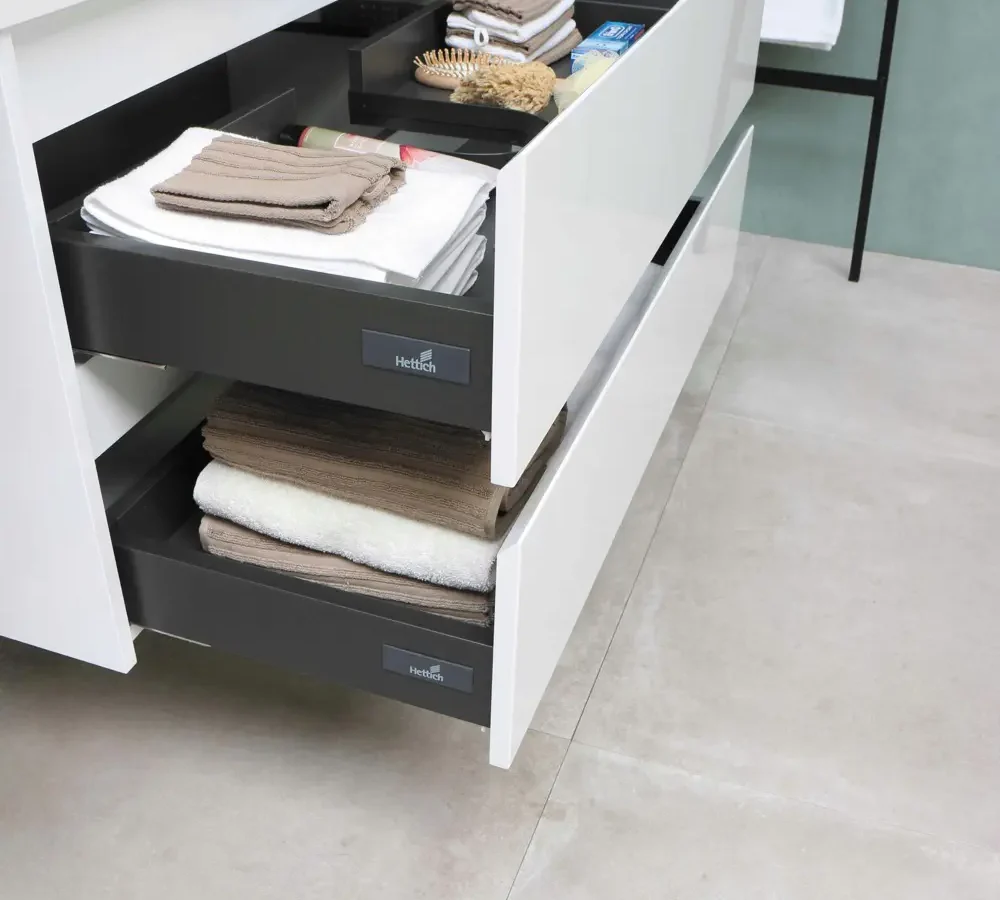
Push-open slides — called tip-on, push-to-open, or impulse slides depending on the manufacturer — contain a spring-loaded catch. Press the drawer front lightly, and a spring releases the drawer to a partially open position. Press again to close.
This mechanism is increasingly popular in modern handleless kitchen design, bathroom vanities, and bedroom furniture where a clean, unbroken surface is the priority.
Key differences from standard slides:
| Feature | Ball Bearing Slides | Push-Open Slides |
|---|---|---|
| Opening mechanism | Pull handle or grip | Press drawer front |
| Load capacity (typical) | 25–70 kg/pair | 20–40 kg/pair |
| Side clearance required | 12.5 mm/side | 12.5–17 mm/side |
| Cost (relative) | Low–medium | Medium–high |
| Extension | 75% or 100% (depends on model) | Usually 75% |
| Installation complexity | Moderate | Higher |
Push-open slides impose a stricter tolerance on drawer front alignment. If the front panel is even 1–2 mm out of square, the spring catch engages unevenly — the drawer pops open at an angle or fails to latch. Precision in your cut list is not optional here.
Some push-open systems (Blum TIP-ON, for example) require a minimum drawer front height of 120 mm to position the actuator correctly. Verify this specification before finalising your panel dimensions.
Clearances, Tolerances, and Your Cut List
Every slide type demands specific gaps that flow directly into your panel dimensions. Getting these numbers into your cut list before cutting is the step most beginners skip — and the reason drawers end up too tight or too loose.
Here is a practical summary of the gaps to plan:
These tolerances need to be in your cut list before a single sheet is optimised. If you are cutting multiple drawers from the same sheet — common in kitchen or workshop cabinet runs — each drawer box component must reflect its corrected dimension. A free panel cut optimizer lets you input exact part dimensions including hardware tolerances, then arranges them for minimum waste across your sheets.
For panel weight estimates when specifying drawer box material (birch ply vs MDF vs melamine particleboard), the wood panel weight calculator gives you accurate per-sheet and per-part figures — useful when calculating slide load requirements.
Conclusion
Choosing between ball bearing, full extension, and push-open drawer slides comes down to three questions: How much weight will the drawer carry? Do you need full access to the drawer contents? And does the design require a handle? For most cabinetry, standard ball bearing slides at the appropriate load rating are the right choice. Full extension slides are worth the extra cost whenever access depth matters. Push-open is a finish-led decision that demands tighter tolerances throughout.
Whatever slide type you choose, the clearances must be in your cut list before you cut. Start your panel layout now with Offcut — enter your drawer box dimensions with hardware tolerances already included and optimise your sheet yield in minutes.